Last updated:
Caffeine Metabolism and Sleep: Why Timing Isn’t One-Size-Fits-All
Introduction
Caffeine is one of the most widely used psychoactive substances in the world, consumed daily through coffee, tea, energy drinks, and supplements. Its effects on alertness are well documented — but its relationship with sleep is more complicated than “don’t drink it late.”
And even with that common advice, many people still consume caffeine later in the day, often without knowing whether or how much it’s affecting their sleep.
A key factor is how quickly your body eliminates caffeine, often described by its elimination half-life. This varies substantially between individuals and helps determine how long caffeine remains active in your system — one important factor in how caffeine may affect sleep onset, sleep quality, and nighttime awakenings. Other factors include dose, timing, habitual use, and individual sensitivity.
What “Caffeine Half-Life” Actually Means
Caffeine doesn’t leave the body all at once. Instead, it declines gradually through metabolic breakdown in the liver, primarily via the enzyme cytochrome P450 1A2 — or CYP1A2.
This process is part of what’s known as elimination, and it begins as soon as caffeine enters circulation, even while absorption is still happening. At first, caffeine enters the bloodstream faster than it’s eliminated, so blood levels rise. Once the rate of elimination exceeds the rate of absorption, blood levels begin to decline as the body continues breaking down and clearing caffeine.
The elimination half-life is the time it takes for the amount of caffeine in the body to decrease by half during the elimination phase, once absorption is no longer contributing substantially to blood levels.
In adults, caffeine’s elimination half-life averages around 5 hours, but can vary considerably between:
- ~1.5 hours (fast elimination)
- ~9.5 hours (slow elimination)
(Institute of Medicine (US) Committee on Military Nutrition Research, 2001)
These aren’t absolute limits. Certain conditions, including pregnancy and significant liver disease, can prolong caffeine elimination beyond this range.
Caffeine Half-Life Is Influenced by Several Factors
- Genetics: Variations in CYP1A2 and regulatory genes such as AHR can influence CYP1A2 enzyme expression and activity.
- Smoking: Compounds in tobacco smoke can induce CYP1A2 activity, increasing caffeine clearance.
- Medications: Certain medications can inhibit or induce CYP1A2 activity. Estrogen-containing contraceptives, for example, can slow caffeine elimination.
- Pregnancy: Caffeine elimination slows substantially during pregnancy, partly due to reduced CYP1A2 activity.
- Liver health and function: Liver conditions that impair metabolic function, such as cirrhosis, can significantly slow caffeine elimination and prolong its half-life.
- Age: Caffeine elimination is much slower in newborns due to immature liver enzymes. Changes in liver function with aging may also affect caffeine metabolism in older adults, although findings are less consistent.
(Grzegorzewski et al., 2022)
Body composition can also influence caffeine pharmacokinetics, though this may be primarily through distribution rather than elimination. There’s also been research on the effects of altitude and hormonal fluctuations, such as changes throughout the menstrual cycle, but so far results have been inconsistent.
What all this means is that different people consuming identical doses of caffeine can have dramatically different timelines of exposure — in part because their bodies eliminate caffeine at different rates.
Simple Elimination Half-Life Examples
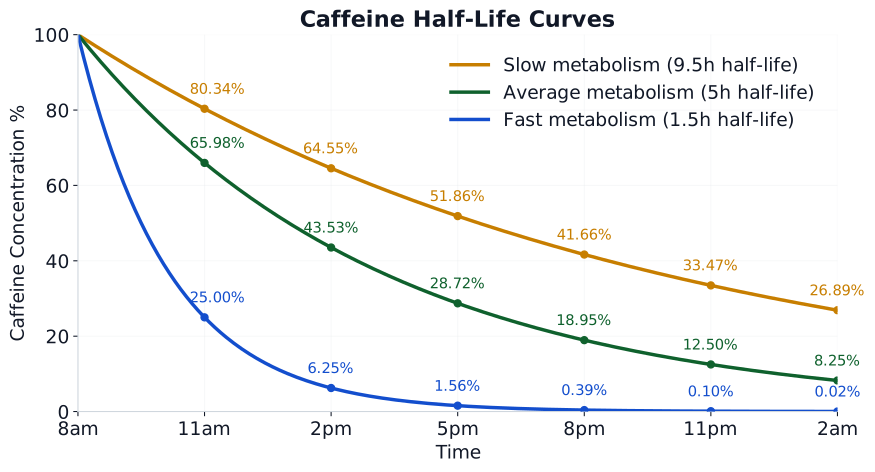
To make this concrete: say you have a cup of coffee at 8 AM, which contains roughly 100 mg of caffeine. Assuming, for simplicity’s sake, that caffeine is absorbed immediately (in reality, absorption is gradual), then:
If your half-life is 1.5 hours, after 1.5 hours you’ll have 50 mg left, then 25 mg after another 1.5 hours. By 4 PM you’re down to about 2.5 mg, and just under 1 mg by 6 PM.
If your half-life is 9.5 hours, it takes until 5:30 PM just to reach 50 mg. By 11 PM, you still have around 33 mg in your system.
If you’re somewhere in the middle — closer to the average 5-hour half-life — that same 8 AM coffee leaves about 13 mg in your system by 11 PM.
The numbers shift dramatically depending on where you fall on that spectrum — and then they shift some more once you account for absorption time, which also varies by person and overlaps with elimination.
Why This Matters for Sleep
Caffeine affects sleep primarily by blocking adenosine receptors, interfering with some of the signaling involved in sleep pressure and wakefulness (Reichert et al., 2022).
But feeling less sleepy doesn’t necessarily mean your underlying need for sleep has disappeared. And even after caffeine’s obvious stimulating effects have worn off, enough may remain in your system to influence sleep.
Research has shown that caffeine can interfere with several aspects of sleep, including how long it takes to fall asleep, total sleep duration, and the amount of time spent in different sleep stages (Gardiner et al., 2023).
These effects aren’t limited to caffeine consumed immediately before bedtime. Depending on the dose and other factors, caffeine consumed hours earlier may still affect subsequent sleep.
Objective vs. Subjective Sleep Quality
How well you think you slept and what happened during sleep are related, but they are not always the same thing.
Caffeine can affect objective sleep measures such as sleep onset latency, total sleep time, sleep efficiency, wake after sleep onset, and sleep-stage distribution. Some of these changes may be noticeable the next morning. Others may be subtle enough that they do not clearly register as “bad sleep,” especially if you are used to your current caffeine routine.
That does not mean subjective sleep quality is useless. If you consistently feel rested, alert, and functional, that matters. But subjective perception can miss gradual or moderate changes in sleep continuity and architecture — particularly when caffeine use, stress, schedule, and accumulated sleep debt are all changing at the same time.
Sleep quality is not just about how you feel when you wake up. It also involves your sleep architecture throughout the night: how much time you spend in each sleep stage, how often you wake up, and how smoothly your brain and body move through the sleep cycles that support recovery, memory, mood, and cognitive performance.
This matters because people are not always good at detecting gradual sleep-related impairment. In a 2003 sleep restriction study, participants who slept 6 or fewer hours per night for 2 weeks developed cognitive performance deficits comparable to up to 2 full nights without sleep, while reporting only modest increases in sleepiness (Van Dongen et al., 2003). That study was about sleep restriction, not caffeine specifically, but it shows why relying only on “I feel fine” can be misleading.
This is why evaluating caffeine’s effect on sleep based on how you feel can be difficult. You may no longer feel stimulated at bedtime, or notice anything unusual the next morning, yet still have caffeine in your system overnight. Whether that remaining caffeine meaningfully affects your sleep depends on your elimination rate, dose, timing, and sensitivity.
For a deeper look at sleep stages and how caffeine can affect them, see:
Sleep Architecture and the Effects of Caffeine
How Much Caffeine Can Disrupt Sleep?
There is no universal amount of caffeine that is “too much” for everyone’s sleep.
The effect depends on several interacting factors:
- how much caffeine you consume
- when you consume it
- how quickly your body clears it
- how sensitive you are to caffeine’s effects
- whether you consume caffeine habitually
- medications, smoking status, pregnancy status, and other biological factors
A 2023 systematic review and meta-analysis of 24 studies found that caffeine consumption, on average:
- reduced total sleep time
- reduced sleep efficiency
- reduced deep sleep
- increased sleep onset latency
- increased wake after sleep onset
- increased light sleep
The analysis also found that dose and timing mattered most clearly for total sleep time: larger doses and caffeine consumed closer to bedtime were associated with greater sleep loss (Gardiner et al., 2023).
What Doses Have Been Shown to Affect Sleep?
Research has found that even relatively small doses of caffeine can affect sleep under certain conditions.
In a 2023 controlled study, just 30 mg of caffeine consumed shortly before sleep significantly increased the amount of time participants spent awake after initially falling asleep. However, the study involved only nine young women, and other sleep measures, including total sleep time and sleep onset latency, did not change significantly (Baba et al., 2023).
Another controlled study found that 100 mg taken at bedtime increased sleep onset latency, reduced sleep efficiency, and altered deep sleep and sleep-related brain activity (Landolt et al., 1995).
But the effects aren’t always consistent across studies. A 2025 randomized crossover study found no statistically significant differences in measured sleep outcomes when 100 mg was consumed 4, 8, or 12 hours before bedtime. In contrast, 400 mg disrupted aspects of sleep even when consumed 12 hours before bedtime. Some of these effects were detected through objective sleep measurements even when participants did not report poorer sleep quality (C. L. Gardiner et al., 2025).
A separate 2025 meta-analysis of 22 controlled trials found that both lower-dose and higher-dose caffeine groups experienced statistically significant reductions in total sleep time and sleep efficiency, along with increased sleep onset latency. Higher-dose caffeine was additionally associated with reduced slow-wave sleep. However, differences between the dose groups were not statistically significant, and the analysis did not establish a consistent linear relationship between dose and sleep disruption (Chang et al., 2025).
These findings show that measurable sleep effects aren’t limited to high caffeine doses, but there is no established minimum dose that disrupts everyone’s sleep. The amount consumed matters, but its effects also depend on when it is consumed and how an individual responds to it.
When Should You Stop Consuming Caffeine?
The 2023 meta-analysis also modeled average cutoff times for different caffeine sources, estimating that a typical cup of coffee containing approximately 107 mg of caffeine may need to be consumed about 8.8 hours before bedtime to avoid a statistically significant reduction in total sleep time.
Lower-caffeine drinks, such as black tea, had shorter modeled cutoffs, while higher-dose products, such as pre-workout supplements, required much earlier cutoffs (C. Gardiner et al., 2023).
But these categories mainly reflect differences in caffeine dose. A large coffee containing as much caffeine as a pre-workout supplement would be expected to behave more like the higher-dose condition than like a smaller “typical” coffee.
Why Average Cutoff Times Can Be Misleading
These cutoff estimates are based on statistical models combining findings from studies with different designs, participants, and outcomes. They provide useful population-level guidance, but they aren’t personalized thresholds.
Another limitation is that some controlled caffeine-sleep studies have recruited only men or narrowly defined groups of healthy participants. Factors such as contraceptive use, pregnancy, smoking, and potential menstrual-cycle-related variation may not be adequately represented in those samples.
This limits how confidently findings from those studies can be generalized to people with different biological characteristics or circumstances.
Habitual caffeine use adds another layer of complexity.
In one controlled study of young male habitual caffeine consumers, repeated daytime caffeine intake did not significantly change total sleep time, sleep latency, broad sleep architecture, or subjective sleep quality during normal nighttime sleep when the last dose was about 8 hours before bed. However, researchers did detect changes in certain sleep-related EEG measurements (Weibel et al., 2021).
A related study from the same research group found that regular daytime caffeine delayed REM sleep promotion and worsened perceived awakening quality when sleep was scheduled later, around the circadian peak of REM sleep (Weibel, Lin, Landolt, Berthomier, et al., 2021).
Together, these findings suggest that regular caffeine consumers may show few differences in conventional nighttime sleep measures, while subtler physiological changes or effects on REM regulation can still emerge under certain conditions.
This further complicates universal cutoff recommendations: caffeine’s effects may depend on habitual use, the timing of sleep relative to the body’s circadian rhythm, and which aspects of sleep are being measured.
TL;DR: Caffeine–Sleep Research Summary
| Evidence | What it suggests | What to keep in mind |
|---|---|---|
| Baba 2023 | Just 30 mg of caffeine shortly before sleep increased time awake after sleep onset. | Small study of nine women; other measured sleep outcomes did not change significantly. |
| Landolt 1995 | 100 mg at bedtime increased sleep latency, reduced efficiency, and altered deep sleep and EEG activity. | Shows that a relatively modest dose can affect sleep, particularly when consumed at bedtime. |
| Gardiner 2023 meta-analysis | Caffeine disrupted multiple sleep measures on average. Higher doses and later consumption were associated with greater reductions in total sleep time. | Its modeled cutoff estimates are population-level predictions, not personalized thresholds. |
| Gardiner 2025 dose-timing study | 100 mg showed no statistically significant sleep effects at the tested times, while 400 mg affected sleep even 12 hours before bedtime. | Some objectively measured changes weren’t reflected in subjective sleep quality, particularly when caffeine was consumed earlier. |
| Chang 2025 meta-analysis | Both lower-dose and higher-dose groups showed significant changes in multiple sleep measures. | Did not establish a universal minimum disruptive dose or consistent linear dose-response relationship. |
| Weibel 2021 studies | Habitual caffeine consumers showed few changes in conventional nighttime sleep measures, but subtler EEG and circadian-dependent REM effects were detected. | Habitual use, sleep scheduling, and the outcomes measured can affect which changes are observed. |
Importantly, most of these studies investigated the amount of caffeine consumed and its timing, rather than directly measuring caffeine concentration throughout the subsequent night.
This distinction matters because the same dose can produce different concentration–time profiles depending on an individual’s absorption, distribution, and elimination. And even at similar concentrations, people may experience different effects because of differences in caffeine sensitivity and habitual use.
The evidence therefore doesn’t establish a single amount of caffeine, or a universal consumption cutoff time, below which everyone’s sleep will be unaffected.
Why Individual Clearance Matters
Even when average cutoff times are based on strong research, they cannot account for everyone’s individual caffeine elimination rate.
For slower metabolizers, standard cutoff times may underestimate how much caffeine is still present at night. For faster metabolizers, those same cutoffs may be unnecessarily restrictive.
And even two people with similar caffeine elimination rates may respond differently to the same remaining concentration because of differences in caffeine sensitivity and habitual use.
This is why a cutoff time that works well for one person may not work as well for another.
What Personalized Caffeine Measurements Add
General caffeine recommendations provide a useful starting point, but they rely on population-level evidence rather than direct measurements of how an individual eliminates caffeine.
Cytio Caffeine Kinetics takes a different approach: using timed saliva samples to measure how caffeine concentrations decline in your body and estimate your personal elimination half-life.
That information can help estimate how caffeine concentrations change over time, including how much may remain relative to an earlier measurement when you’re preparing for sleep.
General Guidelines vs. Personalized Measurements
| General caffeine guidelines | Cytio Caffeine Kinetics |
|---|---|
| Based on population-level evidence | Based on your measured caffeine elimination profile |
| Recommend general cutoff times | Estimates caffeine remaining at any given time, including at night |
| Don’t account for your actual elimination rate | Incorporates your individual elimination half-life |
| Useful starting point | More personalized information for caffeine timing decisions |
Masuring caffeine elimination is only part of the picture. It cannot establish exactly how a given caffeine concentration will affect your sleep on any particular night. Individual sensitivity, habitual consumption, and other biological and environmental factors still matter.
But, by knowing how much caffeine is in your sytem over time and understanding what the research says about how different amounts of caffeine can affect sleep, you can make better, more informed decisions about your caffeine intake and timing.
Key Takeaway
Caffeine doesn’t affect everyone equally, and it doesn’t leave everyone’s body at the same rate.
Population-level research can help us understand how caffeine affects sleep and establish useful general recommendations. But it cannot tell you how quickly your own body clears caffeine.
Understanding your personal caffeine elimination rate adds another piece of information, helping you answer a practical question:
How much caffeine is likely still in my system when I’m trying to sleep?
That’s why we’re developing Cytio Caffeine Kinetics™: an at-home caffeine metabolism test designed to measure your personal caffeine elimination profile and turn it into practical timing insights for sleep planning, focus, exercise, travel, and everyday performance.
References
- Baba, Y., Takihara, T., & Okamura, N. (2023). Theanine maintains sleep quality in healthy young women by suppressing the increase in caffeine-induced wakefulness after sleep onset. Food & Function, 14(15), 7109–7116. https://doi.org/10.1039/d3fo01247f
- Chang, Y.-H., Cheng, Y.-C., & Cheng, W.-J. (2025). Age- and dose-specific effects of caffeine on sleep: A meta-analysis of controlled crossover trials. Sleep Medicine, 136, 106874. https://doi.org/https://doi.org/10.1016/j.sleep.2025.106874
- Gardiner, C. L., Weakley, J., Burke, L. M., Fernandez, F., Johnston, R. D., Leota, J., Russell, S., Munteanu, G., Townshend, A., & Halson, S. L. (2025). Dose and timing effects of caffeine on subsequent sleep: a randomized clinical crossover trial. Sleep, 48(4). https://doi.org/10.1093/sleep/zsae230
- Gardiner, C., Weakley, J., Burke, L. M., Roach, G. D., Sargent, C., Maniar, N., Townshend, A., & Halson, S. L. (2023). The effect of caffeine on subsequent sleep: A systematic review and meta-analysis. Sleep Medicine Reviews, 69, 101764. https://doi.org/10.1016/j.smrv.2023.101764
- Grzegorzewski, J., Bartsch, F., Köller, A., & König, M. (2022). Pharmacokinetics of Caffeine: A Systematic Analysis of Reported Data for Application in Metabolic Phenotyping and Liver Function Testing. Frontiers in Pharmacology, 12, 752826. https://doi.org/10.3389/fphar.2021.752826
- Institute of Medicine (US) Committee on Military Nutrition Research. (2001). Caffeine for the Sustainment of Mental Task Performance: Formulations for Military Operations. National Academies Press (US). https://www.ncbi.nlm.nih.gov/books/NBK223808/
- Landolt, H. P., Dijk, D. J., Gaus, S. E., & Borbély, A. A. (1995). Caffeine reduces low-frequency delta activity in the human sleep EEG. Neuropsychopharmacology, 12(3), 229–238. https://pubmed.ncbi.nlm.nih.gov/7612156/
- Reichert, C. F., Deboer, T., & Landolt, H.-P. (2022). Adenosine, caffeine, and sleep-wake regulation: state of the science and perspectives. Journal of Sleep Research, 31(4), e13597. https://doi.org/10.1111/jsr.13597
- Van Dongen, H. P. A., Maislin, G., Mullington, J. M., & Dinges, D. F. (2003). The Cumulative Cost of Additional Wakefulness: Dose-Response Effects on Neurobehavioral Functions and Sleep Physiology From Chronic Sleep Restriction and Total Sleep Deprivation. Sleep, 26(2), 117–126. https://doi.org/10.1093/sleep/26.2.117
- Weibel, J., Lin, Y.-S., Landolt, H.-P., Berthomier, C., Brandewinder, M., Kistler, J., Rehm, S., Rentsch, K. M., Meyer, M., Borgwardt, S., Cajochen, C., & Reichert, C. F. (2021). Regular Caffeine Intake Delays REM Sleep Promotion and Attenuates Sleep Quality in Healthy Men. J. Biol. Rhythms, 36(4), 384–394. https://doi.org/10.1177/07487304211013995
- Weibel, J., Lin, Y.-S., Landolt, H.-P., Kistler, J., Rehm, S., Rentsch, K. M., Slawik, H., Borgwardt, S., Cajochen, C., & Reichert, C. F. (2021). The impact of daily caffeine intake on nighttime sleep in young adult men. Scientific Reports, 11(1), 4668. https://doi.org/10.1038/s41598-021-84088-x