Last updated:
What Sleep Stages Actually Do
TL;DR: Sleep is not one uniform state. A typical night cycles through N1, N2, N3, and REM sleep, and each stage supports different brain and body processes. N3 is most tied to slow-wave recovery physiology, while REM supports dreaming, emotional processing, and procedural memory.
Sleep is often treated as one thing: you are either asleep or awake. But in reality, it’s a bit more complex than that.
Across a normal night, the brain cycles through distinct stages with different electrical patterns, neurochemistry, body physiology, and functional roles. Some stages are light and transitional. Some are deep and synchronized. Others look almost wake-like in the brain while the body is largely paralyzed.
Understanding these stages matters because sleep quality is not just about total hours. Two nights can both be eight hours long and still differ in slow-wave sleep, REM timing, fragmentation, and recovery physiology.
This article is a primer on the architecture itself: what each stage does, how the stages change across the night, and why disruption to sleep structure can matter even when total sleep time looks adequate. For the caffeine-specific version, see How Caffeine Changes Sleep Architecture.
The Architecture of a Night
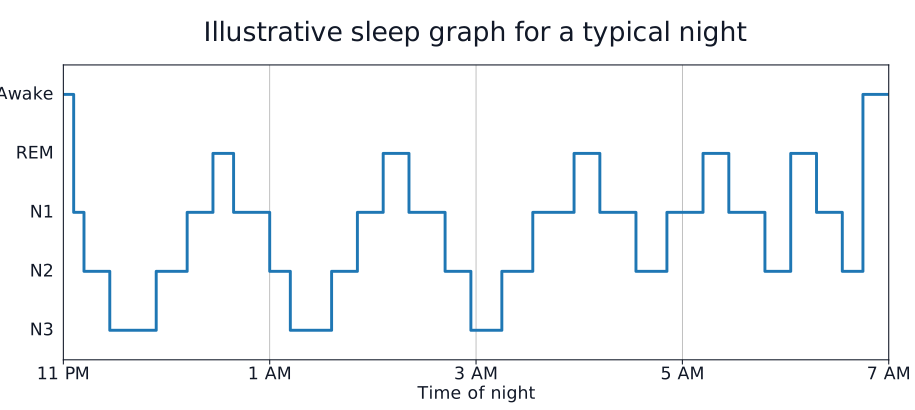
Sleep alternates between non-REM (NREM) and REM sleep in cycles of roughly 90 minutes. Most adults complete about 4 to 6 cycles per night.
The cycles are not identical:
- The first half of the night is weighted toward deep NREM sleep, especially N3.
- The second half of the night has progressively longer REM episodes and less N3.
That asymmetry matters. Early-night slow-wave sleep and late-night REM are not interchangeable. If the first cycle is delayed, fragmented, or compressed, the brain does not simply recreate that exact missed architecture later. The night continues shifting toward its later REM-heavy pattern.
Sleep Stages at a Glance
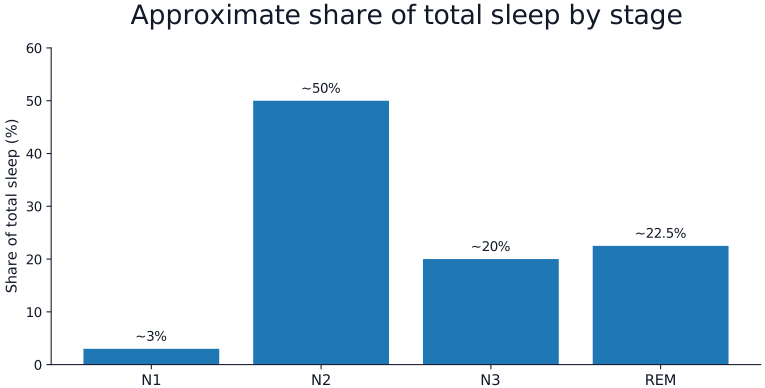
| Stage | Approx. share of sleep | Main features | Key functions |
|---|---|---|---|
| N1 | 1–5% | Transition, slow eye movements | Sleep onset |
| N2 | 45–55% | Spindles, K-complexes | Sensory gating, memory processing |
| N3 | 15–25% | Delta waves, high slow-wave activity | Growth hormone, memory consolidation, glymphatic clearance, metabolic regulation |
| REM | 20–25% | Wake-like EEG, muscle atonia | Emotional processing, dreaming, procedural memory |
N1: The Threshold
N1 is the brief transition from wakefulness into sleep. On an EEG, the rhythm of relaxed wakefulness fades and is replaced by slower, lower-amplitude activity. The eyes make slow rolling movements. Muscle tone drops modestly.
People woken from N1 often say they were not asleep at all. This is also the stage where hypnic jerks — sudden falling-sensation twitches — commonly occur.
Functionally, N1 is closer to releasing wakefulness than to deep restoration. The doorway, not the room.
N2: The Workhorse
N2 makes up the largest share of adult sleep. It’s lighter than N3 but more stable than N1, and it contains two defining EEG events: sleep spindles and K-complexes.
Sleep spindles are brief rhythmic bursts of brain activity produced by circuits connecting the thalamus and cortex. They appear to help gate sensory input, reducing the chance that minor disturbances will wake you. They are also linked to memory consolidation, especially the stabilization of newly learned information.
K-complexes are large, slow electrical waves that can appear spontaneously or in response to a stimulus, such as a sound. Their exact function is still debated, but they appear to help suppress arousal while participating in ongoing sleep-dependent processing.
N2 is not the deepest stage, but it is not filler. It is where much of the night is spent, and it helps maintain sleep continuity while supporting memory-related work.
N3: Slow-Wave Sleep
N3 is what most people mean by “deep sleep.” Its EEG signature is delta activity: large, slow oscillations around 0.5 to 4 Hz, generated by broad populations of cortical neurons firing in synchrony.
This stage is strongly tied to homeostatic sleep pressure. It is usually most concentrated in the first half of the night, especially the first few sleep cycles.
N3 supports several major processes:
- Growth hormone release. The largest daily pulse of growth hormone secretion is linked to early-night slow-wave sleep. Growth hormone supports tissue repair, muscle protein synthesis, and metabolic regulation.
- Declarative memory consolidation. Memories involving facts, events, and experiences are stabilized through interactions between the hippocampus and cortex.
- Synaptic recalibration. One influential hypothesis proposes that slow-wave sleep helps downscale weaker synaptic connections while preserving more important ones, improving the brain’s signal-to-noise ratio for the next day.
- Glymphatic clearance. The brain’s waste-clearance system appears to be especially active during NREM sleep and slow-wave sleep.
- Physical recovery. N3 is associated with reduced sympathetic activity, lower metabolic rate, and a physiology more favorable to repair and regulation.
N3 is also the hardest stage to wake from. If you are awakened during deep sleep, you may experience sleep inertia: grogginess, disorientation, and impaired cognition that can last for minutes after waking.
REM: The Paradox
REM sleep is often called paradoxical sleep because the brain looks active while the body is deeply inhibited.
On EEG, REM can resemble wakefulness: fast, variable activity replaces the large slow waves of N3. At the same time, most voluntary muscles are temporarily paralyzed. Brainstem circuits block motor output so that dream activity is not physically acted out.
REM also has a distinct neurochemical profile.
| REM feature | What happens |
|---|---|
| Brain activity | Wake-like, fast, variable EEG |
| Muscle tone | Most voluntary muscles inhibited |
| Neurochemistry | High acetylcholine; low norepinephrine, serotonin, histamine |
| Major roles | Emotional processing, procedural memory, dreaming, associative cognition |
Acetylcholine systems are highly active during REM, supporting cortical activation. Meanwhile, norepinephrine, serotonin, and histamine systems fall to very low activity levels. This unusual combination may help the brain process emotional memories in a state that is active but less dominated by the stress chemistry of wakefulness.
REM is associated with vivid dreaming, emotional memory processing, procedural learning, creative association, and late-night sleep architecture. In men, nocturnal testosterone levels begin rising around the first REM episode and are maintained through the night when sleep remains stable; sleep restriction and severe fragmentation are associated with reduced testosterone levels (Andersen & Tufik, 2008; Leproult & Van Cauter, 2011).
Sleep Is a Whole-Body Process
Sleep stages are brain states, but their effects are not limited to the brain. Changes in sleep architecture can show up in cardiovascular function, metabolism, immune signaling, hormonal rhythms, and waste clearance.
The body does not simply “power down” during sleep. It changes mode.
Cardiovascular Recovery
During NREM sleep, especially slow-wave sleep, sympathetic nervous system activity decreases. Heart rate slows, blood vessels relax, and blood pressure normally drops. In healthy adults, this overnight reduction in blood pressure is called nocturnal dipping and typically falls around 10 to 20% below daytime levels (Casagrande et al., 2020).
This dip matters clinically. People whose blood pressure does not dip sufficiently overnight — often called “non-dippers” — have higher cardiovascular risk, independent of average daytime blood pressure (Ohkubo et al., 2002).
Slow-wave sleep appears to help support this recovery window. Selective suppression of slow-wave sleep can attenuate nocturnal blood pressure dipping even when total sleep time is preserved (Sayk et al., 2010).
Metabolic and Hormonal Regulation
Sleep architecture also affects metabolic function.
In a controlled study, selectively suppressing slow-wave sleep for three nights in healthy young adults reduced insulin sensitivity by approximately 25% without reducing total sleep time (Tasali et al., 2008). That finding is important because it shows that sleep structure, not just sleep duration, can influence glucose regulation.
Sleep also interacts with appetite-regulating hormones. Spiegel and colleagues found that short sleep in healthy young men lowered leptin, raised ghrelin, and increased self-reported hunger and appetite (Spiegel et al., 2004). Later research has shown that the relationship is complex, especially under free-living conditions, but the broader link between insufficient sleep and metabolic dysregulation remains well supported.
Immune Function
Sleep supports immune coordination. During early nocturnal NREM sleep, immune signaling shifts in ways that support inflammatory coordination and adaptive immune memory (Besedovsky et al., 2012).
Sleep deprivation studies have found impaired antibody responses to vaccination and reduced natural killer cell activity. The details are still being actively studied, but the broad point is clear: sleep is part of immune regulation, not just recovery from feeling tired.
Glymphatic Clearance
The glymphatic system is a brain-wide waste-clearance pathway that uses cerebrospinal fluid to help remove metabolic byproducts from the spaces between brain cells. These waste products include proteins such as beta-amyloid and tau, which are associated with neurodegenerative disease.
Glymphatic clearance is strongly sleep-dependent. During NREM sleep, the space between brain cells expands, allowing cerebrospinal fluid to move more freely through tissue. Clearance appears especially active during slow-wave sleep.
A 2025 study added a mechanistic detail: during NREM sleep, norepinephrine is released in slow rhythmic pulses from the locus coeruleus. These pulses drive slow vasomotion — rhythmic changes in blood vessel diameter — that help propel cerebrospinal fluid flow through the brain (Hauglund et al., 2025).
The practical implication is not that one disrupted night is catastrophic. It is that sleep architecture creates the conditions for this clearance system to work well, and repeated disruption of slow-wave sleep may reduce time spent in the state most favorable to that process.
Why Total Sleep Time Is Not Enough
Total sleep time is useful, but it is not the full story. A night of sleep can be long but fragmented, or long but low in slow-wave activity, or long but shifted away from normal REM timing.
That’s why sleep architecture matters.
For example:
- Normal sleep duration but reduced N3 may still affect metabolic regulation, cardiovascular recovery, and the sleep conditions that support glymphatic clearance.
- Frequent brief arousals (which you usually don’t remember) disrupt sleep continuity, and even with normal total sleep time, can result in increased fatique, impaired inhibition, and weaker overnight motor memory consolidation (Benkirane et al., 2022; Djonlagic et al., 2012).
- REM disruption is associated with impaired emotional processing and emotional regulation, even after just one night (Goldstein & Walker, 2014).
This is also why subjective sleep quality can be misleading. The brain does not give you a detailed report in the morning: “Your delta power was down 14%, please adjust accordingly.” You usually get only a vague sense of whether you slept well.
What Disrupts Sleep Architecture
Many factors can alter sleep structure:
- Caffeine and other stimulants
- Alcohol
- Sleep apnea or breathing disruptions
- Stress and hyperarousal
- Irregular sleep timing
- Light exposure at night
- Certain medications
- Pain, illness, or inflammation
- Environmental noise
- Circadian misalignment from travel or shift work
Different disruptors affect architecture in different ways. Alcohol, for example, may initially reduce sleep latency but later fragments sleep and suppresses REM. Caffeine primarily interferes with adenosine signaling and can reduce slow-wave sleep when active near bedtime.
The common thread is that sleep quality is not just whether you were unconscious for enough hours. It is whether the night preserved the stage structure your brain and body were trying to run.
Bottom Line
Sleep is a structured sequence, not a single passive state. N1 helps transition out of wakefulness. N2 supports sensory gating and memory processing. N3 provides slow-wave physiology tied to deep recovery, metabolic regulation, cardiovascular dipping, and glymphatic clearance. REM supports dreaming, emotional integration, procedural learning, and associative cognition.
That structure is why disruptions can matter even when total sleep time looks normal. The question is not only “how long did you sleep?” It is also “what kind of sleep did you get?”
References
- Andersen, M. L., & Tufik, S. (2008). The effects of testosterone on sleep and sleep-disordered breathing in men: its bidirectional interaction with erectile function. Sleep Medicine Reviews, 12(5), 365–379. https://doi.org/10.1016/j.smrv.2007.12.003
- Benkirane, O., Delwiche, B., Mairesse, O., & Peigneux, P. (2022). Impact of Sleep Fragmentation on Cognition and Fatigue. Int J Environ Res Public Health, 19(23). https://doi.org/10.3390/ijerph192315485
- Besedovsky, L., Lange, T., & Born, J. (2012). Sleep and immune function. Pflügers Archiv: European Journal of Physiology, 463(1), 121–137. https://doi.org/10.1007/s00424-011-1044-0
- Casagrande, M., Favieri, F., Langher, V., Guarino, A., Di Pace, E., Germanò, G., & Forte, G. (2020). The Night Side of Blood Pressure: Nocturnal Blood Pressure Dipping and Emotional (dys)Regulation. International Journal of Environmental Research and Public Health, 17(23). https://doi.org/10.3390/ijerph17238892
- Djonlagic, I., Saboisky, J., Carusona, A., Stickgold, R., & Malhotra, A. (2012). Increased sleep fragmentation leads to impaired off-line consolidation of motor memories in humans. PLoS One, 7(3), e34106. https://doi.org/10.1371/journal.pone.0034106
- Goldstein, A. N., & Walker, M. P. (2014). The role of sleep in emotional brain function. Annual Review of Clinical Psychology, 10, 679–708. https://doi.org/10.1146/annurev-clinpsy-032813-153716
- Hauglund, N. L., Andersen, M., Tokarska, K., Radovanovic, T., Kjaerby, C., Sørensen, F. L., Bojarowska, Z., Untiet, V., Ballestero, S. B., Kolmos, M. G., Weikop, P., Hirase, H., & Nedergaard, M. (2025). Norepinephrine-mediated slow vasomotion drives glymphatic clearance during sleep. Cell, 188(3), 606-622.e17. https://doi.org/10.1016/j.cell.2024.11.027
- Leproult, R., & Van Cauter, E. (2011). Effect of 1 week of sleep restriction on testosterone levels in young healthy men. JAMA, 305(21), 2173–2174. https://doi.org/10.1001/jama.2011.710
- Ohkubo, T., Hozawa, A., Yamaguchi, J., Kikuya, M., Ohmori, K., Michimata, M., Matsubara, M., Hashimoto, J., Hoshi, H., Araki, T., Tsuji, I., Satoh, H., Hisamichi, S., & Imai, Y. (2002). Prognostic significance of the nocturnal decline in blood pressure in individuals with and without high 24-h blood pressure: the Ohasama study. J Hypertens, 20(11), 2183–2189. https://doi.org/10.1097/00004872-200211000-00017
- Sayk, F., Teckentrup, C., Becker, C., Heutling, D., Wellhöner, P., Lehnert, H., & Dodt, C. (2010). Effects of selective slow-wave sleep deprivation on nocturnal blood pressure dipping and daytime blood pressure regulation. American Journal of Physiology: Regulatory, Integrative and Comparative Physiology, 298(1), R191–R197. https://doi.org/10.1152/ajpregu.00368.2009
- Spiegel, K., Tasali, E., Penev, P., & Van Cauter, E. (2004). Brief communication: Sleep curtailment in healthy young men is associated with decreased leptin levels, elevated ghrelin levels, and increased hunger and appetite. Annals of Internal Medicine, 141(11), 846–850. https://doi.org/10.7326/0003-4819-141-11-200412070-00008
- Tasali, E., Leproult, R., Ehrmann, D. A., & Van Cauter, E. (2008). Slow-wave sleep and the risk of type 2 diabetes in humans. Proceedings of the National Academy of Sciences, 105(3), 1044–1049. https://doi.org/10.1073/pnas.0706446105